
Likeability is a question of follow-up
Have you ever felt lonelier and less observed in conversation, than entirely alone? It’s a bizarre experience. The person you’re talking to just is there technically, but not listening or building in anyway on what you say. That type of exchange isn’t intentionally rude - but it is unpleasant, unproductive and critically - unsound.
The reality is - the person is probably totally unaware - they’re just excited to talk about what they want to talk about - and so they do. The other reality is - we do this at times ourselves - launch into a story inspired by someone else’s, rather than truly listen. The fix is very small: ask one more question.
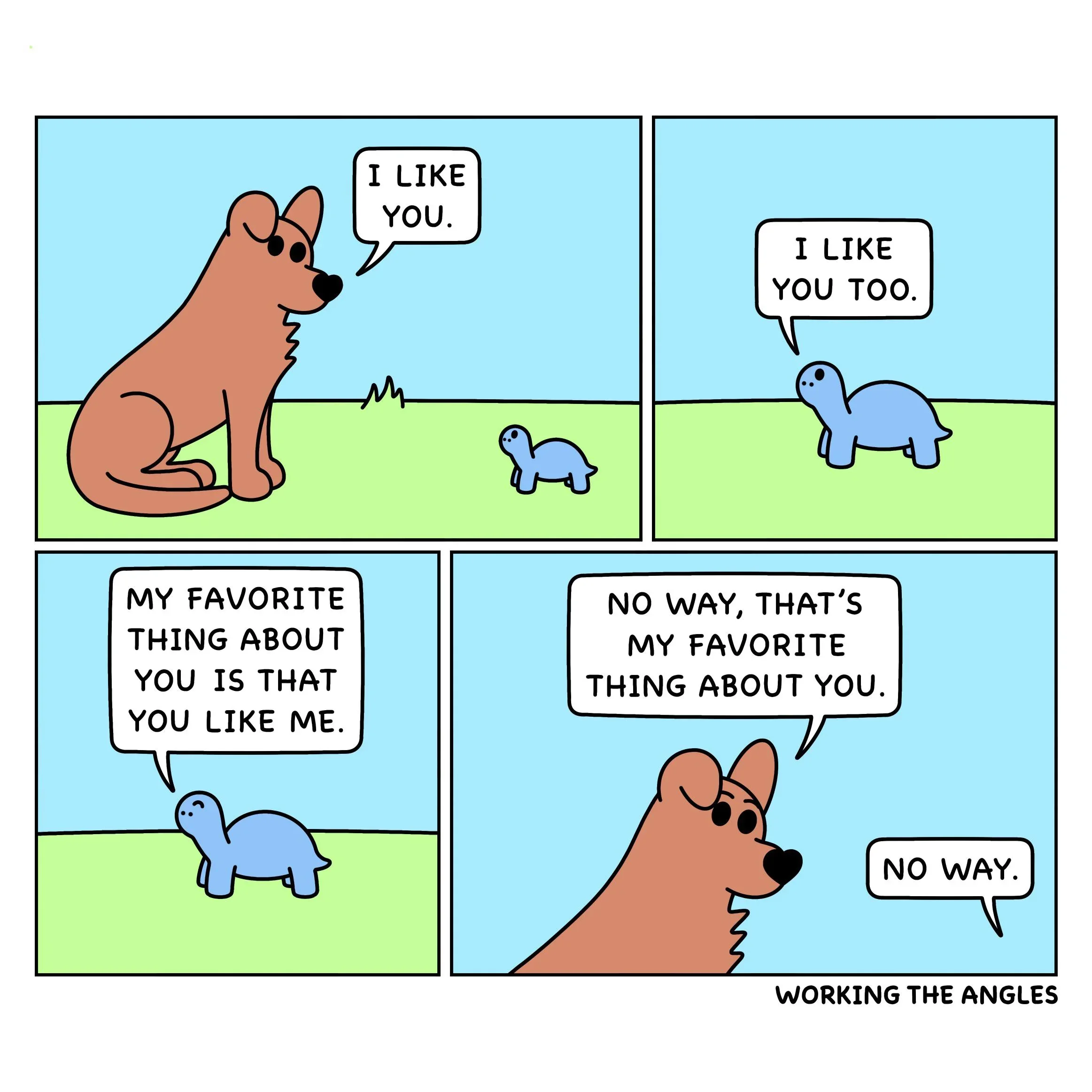
Likeability is largely driven by curiosity.
What the research says
Harvard researchers studied what happens when people ask questions in live conversations. Across three studies, people who asked more questions, particularly follow-up questions, were better liked by their conversation partners.
One study looked at speed dating. Daters who asked more follow-up questions were more likely to get a yes to a second date.
The twist is that people don't expect question-asking to make them more likeable. So most of us don't do it nearly enough.
Not all questions are equal
Researchers analysing get-to-know-you conversations found four dominant question types.
Introductory: the routine opener at the start of a conversation. "How was your day?"
Mirror: bouncing someone's question straight back. "Good, thanks. How was yours?"
Topic-switching: moving to something new. "Anyway, did you see the news?"
Follow-up: building on what the other person has just said. "You said work was stressful. What happened?"
Only one of these types of questions reliably makes you a more likeable conversation partner - the follow-up.
Why follow-ups work
The researchers found that asking questions made people seem more responsive, which captures listening, understanding, validation and care. A follow-up question is proof you were listening, not just waiting to talk about your weekend of hiking or your favourite Thai food.
How to ask a better follow-up
Build on their words: Pick up something they said ("stressful", "finally", "a bit much") and ask about it.
Ask for the story: "What happened next?" opens more doors than "How was it?"
Ask what it meant: "What did that mean for you?" moves from facts to what matters.
Try this
In your next conversation, notice which type of question you reach for first. Then ask one follow-up before you share your own story. Let me know how it goes!
Sources
Huang, K., Yeomans, M., Brooks, A. W., Minson, J., & Gino, F. (2017). It doesn't hurt to ask: Question-asking increases liking. Journal of Personality and Social Psychology, 113(3), 430-452.
Yeomans, M., Brooks, A. W., Huang, K., Minson, J., & Gino, F. (2019). It helps to ask: The cumulative benefits of asking follow-up questions. Journal of Personality and Social Psychology, 117(6), 1139-1144.
Harvard Business School Working Knowledge (2025). The elements of meaningful conversation: Fewer mirror questions, more follow-ups