
Success is social: here’s why
Everyone knows Thomas Edison invented the lightbulb. We can conjure the image of him alone in his laboratory, we can see him having a flash of genius, then - one two, skip a few - he changed the world. It is one of the most repeated origin stories in the history of innovation. It is also, in almost every important detail, wrong.
By 1880, nearly eighty men worked across multiple specialised buildings at Edison's Menlo Park complex in New Jersey. There was a machine shop, a glass workshop, a carpenter's shop, a library. There was Charles Batchelor, an English mechanic who served as Edison's principal experimental assistant and had worked alongside him for years.
There was Francis Upton, a mathematician and physicist who performed the advanced calculations that turned Edison's intuitions into workable designs. There was John Kruesi, a Swiss machinist who could translate a rough sketch into a functioning prototype faster than almost anyone alive. This is the team that invented the lightbulb.
Edison's real genius perhaps was not the lightbulb - it was understanding that innovation is a team sport. However, as a society - we took his story, discarded the messy reality of the team message, kept the name on the patent, and have been telling ourselves the wrong lesson about individual brilliance ever since.
The reason this matters is not the historical accuracy but the implications for how we think about work. We hire individuals, we assess individuals, we promote individuals. And in doing so, we have built systems that often lead us to ignore how interdependent we are and focus on our own success.

To understand why this individual focus fails us, you need to understand what Ronald Burt spent his career untangling. Burt arrived at university planning to become a doctor, but a question started nagging at him that anatomy and biochemistry could not answer: why do people do what they do? He moved from pre-med into social psychology.
His dissertation, completed in 1977, was about patterns of exchange between companies. He was trying to understand why some organisations consistently outperformed others that looked, on paper, almost identical. And what he kept finding, in the data, was the same thing over and over: the answer was almost never about what was inside a given group. It was about who that group was connected to outside itself.
He called the gaps between those groups structural holes, and he spent the next three decades proving that the people who sat across those gaps -- who bridged the distance between otherwise disconnected worlds -- were the ones everything else in an organisation flowed toward: the ideas, the promotions, the compensation, the recognition.
In 2000, Burt was hired by Raytheon, the large American electronics and defence company, as Vice President of Strategic Learning. His job was to help integrate a group of recent acquisitions -- to understand why some parts of the business generated ideas and others didn't. He designed a study where he asked 673 managers across Raytheon's supply chain to write down their best ideas for how to improve business operations. Two senior executives then rated the quality of those ideas independently, without knowing which manager had submitted which.
The results were not what Raytheon expected. The highest-rated ideas did not come from the most experienced managers, or the most senior, or the deepest technical specialists. They came from managers whose networks spanned structural holes -- the gaps between otherwise disconnected groups inside the organisation. People who sat at the intersection of different teams, different functions, different social worlds. People who knew people that their colleagues did not know.
The reason is simple once you see it - groups that only talk to themselves develop shared blind spots. The person who moves between those groups -- who carries information from one world into another where it is genuinely new -- has access to something no amount of individual brilliance can replicate. They have the ability to see options that are invisible to everyone who has stayed in their lane.
Burt called it information arbitrage and he was not the first to see this. He was the first to prove it in an organisational context, with data that boardrooms could not easily dismiss. But the intellectual thread runs further back -- to a graduate student at Harvard in the late 1960s who was asking a deceptively simple question from a completely different direction.
Mark Granovetter, for his dissertation at Harvard, studied how people find jobs. He went to Newton, Massachusetts, and started asking people, one by one, how they had found their current position.
What he found was that the people who found the best jobs -- who made the most successful transitions, who accessed the most promising opportunities -- did not find them through their closest contacts. They found them through their weakest ones. Through the colleague they saw occasionally at a conference or the former boss they emailed once a year. The acquaintance from a previous role who happened to mention something in passing at an event.
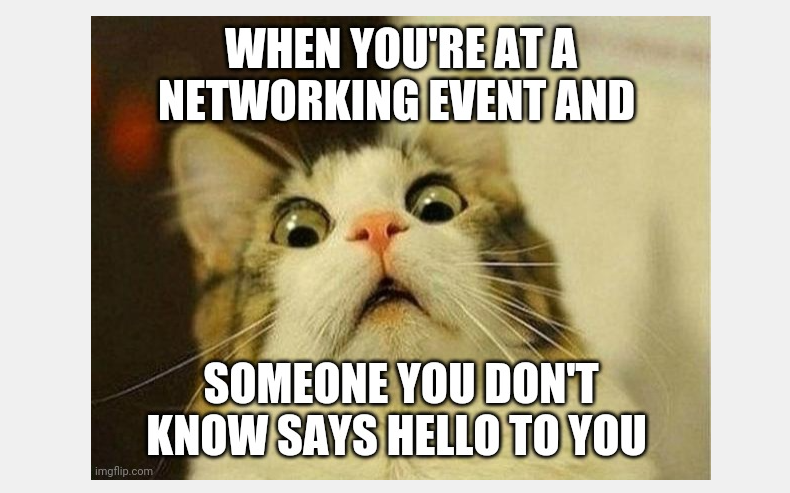
Networking can be challenging, but it’s also incredibly helpful.
The finding has since been validated at a scale Granovetter could never have imagined. In 2022, researchers ran experiments on LinkedIn involving 20 million people over five years -- the largest empirical test of weak tie theory in the labour market to date. The finding held: a person's weakest ties were the most helpful for career advancement, particularly in fast-moving, knowledge-intensive industries.
These three stories all point to one key habit that can drive our success in our careers: being social. Individual brilliance without connection is a library with no door - we need others to unearth, improve and execute our ideas.
So what’s the habit to encourage in ourselves and our teams: keep up with your network - go to the events - grab the coffee - keep expanding your reach.